Popular Kitchen Cabinets
Discover Forevermark RTA Kitchen Cabinets
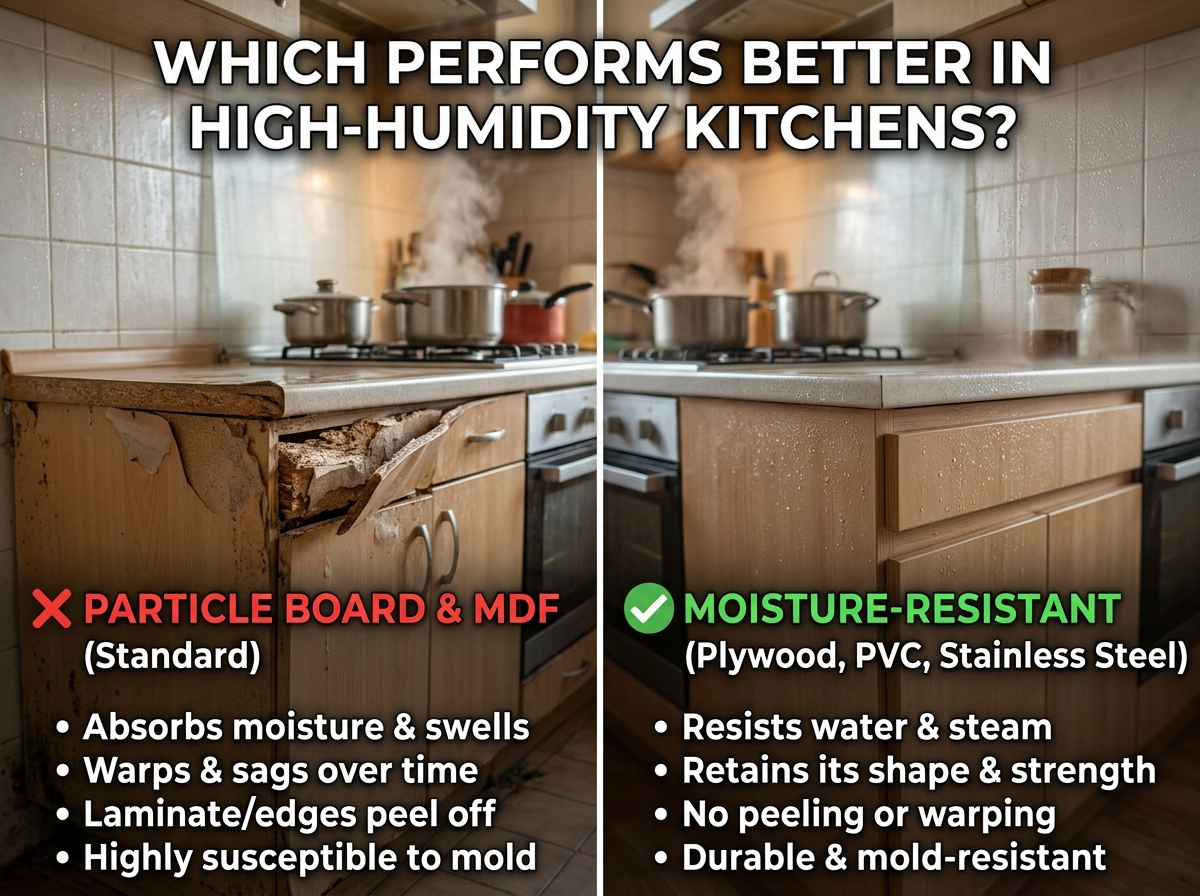
Which Performs Better in High-Humidity Kitchens? This question becomes especially important when homeowners compare kitchen cabinet materials for environments exposed to frequent cooking, steam, condensation, and changing indoor humidity. Although cabinet colors and door styles influence the appearance of a kitchen, the materials used beneath the finish often determine how well cabinetry performs over time.
High humidity can affect cabinet doors, shelves, drawer fronts, and cabinet boxes. Depending on the material and construction, prolonged moisture exposure may contribute to swelling, warping, finish deterioration, or weakened joints. These problems are particularly relevant in kitchens with limited ventilation, frequent cooking activity, or recurring condensation.
Plywood, medium-density fiberboard (MDF), solid wood, and particleboard are among the most commonly compared kitchen cabinet materials. Each responds differently to moisture, and none should be considered completely waterproof. Protective finishes, edge sealing, manufacturing quality, and installation conditions can be just as important as the material itself.
At Cabinets House, choosing kitchen cabinetry involves evaluating durability alongside appearance, storage, and overall value. Understanding how cabinet materials perform in humid environments can help homeowners make informed decisions and avoid unnecessary repairs or premature replacement.
Kitchen cabinets are constantly exposed to environmental changes. Boiling water, dishwashers, cooking steam, and insufficient ventilation can increase indoor moisture levels, particularly in enclosed kitchens.
Wood and wood-based materials absorb and release moisture as surrounding conditions change. This process can cause dimensional movement, affecting door alignment, panel stability, and the appearance of painted or laminated surfaces.
Excessive moisture can also damage exposed cabinet edges. If water reaches an unprotected substrate, certain engineered wood products may swell and lose their original shape. Once significant swelling occurs, the damage may not be reversible.
Humidity should also be distinguished from direct water exposure. A cabinet material that performs reasonably well in humid air may still deteriorate when exposed to a persistent plumbing leak or standing water.
Maintaining stable indoor conditions and addressing leaks promptly are essential regardless of cabinet construction.
Plywood is frequently considered a strong option for kitchen cabinet boxes because its layered construction provides useful dimensional stability.
Quality plywood consists of multiple wood veneer layers bonded together, typically with alternating grain directions. This arrangement helps reduce some of the movement associated with solid wood panels.
In kitchens exposed to fluctuating humidity, appropriately manufactured plywood can maintain structural performance when properly finished and installed. Its strength and fastener-holding characteristics also make it suitable for many cabinet box applications.
However, plywood is not automatically waterproof. Performance depends on the panel grade, adhesive system, veneer quality, exposed-edge protection, and duration of moisture exposure.
For homeowners comparing cabinet materials, quality plywood is often a practical choice for structural components, especially when moisture management is a priority.
Medium-density fiberboard, commonly known as MDF, is widely used in cabinet doors and decorative panels because of its smooth, consistent surface.
MDF is particularly attractive for painted cabinetry. Unlike natural wood, it does not contain prominent grain patterns that may become visible beneath paint.
However, standard MDF can absorb moisture through exposed edges, damaged finishes, and poorly sealed openings. Excessive exposure may cause swelling that affects the panel’s dimensions and surface appearance.
Moisture-resistant MDF products are available for certain applications, but their performance depends on the manufacturer’s specifications. Moisture-resistant does not mean waterproof.
MDF can still be appropriate for kitchen cabinet doors when the material is properly manufactured, sealed, finished, and protected from prolonged water exposure.
Solid wood is valued for its natural appearance, durability, and traditional cabinet construction. However, it responds to environmental humidity differently from engineered wood products.
As moisture levels change, solid wood expands and contracts. This natural movement can affect door panels, joints, and alignment, particularly when humidity fluctuates significantly.
Properly constructed solid wood cabinet doors accommodate some of this movement through their design. Protective finishes can help moderate moisture exchange, although they do not eliminate it completely.
Different wood species also have different movement characteristics. Manufacturing methods, grain orientation, and environmental conditions influence performance.
Solid wood can perform well in kitchens with controlled humidity, but homeowners should not assume that it is inherently more moisture-resistant than quality plywood.
Particleboard is commonly used in budget-oriented cabinetry and furniture. It consists of wood particles bonded into panels using adhesives and manufacturing processes.
Its affordability makes it attractive for certain cabinet applications, especially when combined with decorative laminates or melamine surfaces.
However, standard particleboard can be vulnerable to moisture penetration, particularly along exposed edges, damaged surfaces, and fastening points.
Prolonged water exposure may cause swelling, deterioration, and reduced structural performance. Moisture-resistant grades exist, but their suitability must be evaluated according to product specifications.
Particleboard should not automatically be dismissed as unsuitable for every kitchen. Properly manufactured panels can provide acceptable performance under controlled conditions. Nevertheless, moisture protection and installation quality are particularly important.
The following comparison summarizes the general characteristics of common kitchen cabinet materials.
| Cabinet Material | Response to Humidity | Main Advantage | Main Concern |
|---|---|---|---|
| Quality Plywood | Generally dimensionally stable | Strong cabinet box construction | Exposed edges and prolonged water exposure |
| Standard MDF | Sensitive to moisture penetration | Smooth painted surfaces | Swelling at damaged or unsealed edges |
| Moisture-Resistant MDF | Improved performance under specified conditions | Suitable for selected painted components | Not waterproof |
| Solid Wood | Expands and contracts with humidity | Natural appearance and repairability | Seasonal movement |
| Standard Particleboard | Vulnerable to prolonged moisture | Affordable and consistent panels | Swelling and edge deterioration |
| Moisture-Resistant Particleboard | Improved resistance in intended applications | Cost-effective engineered construction | Requires proper sealing and protection |
For many high-humidity kitchens, quality plywood is a strong choice for cabinet boxes, while properly sealed MDF or solid wood may be suitable for doors. The ideal construction often combines materials according to their intended functions.
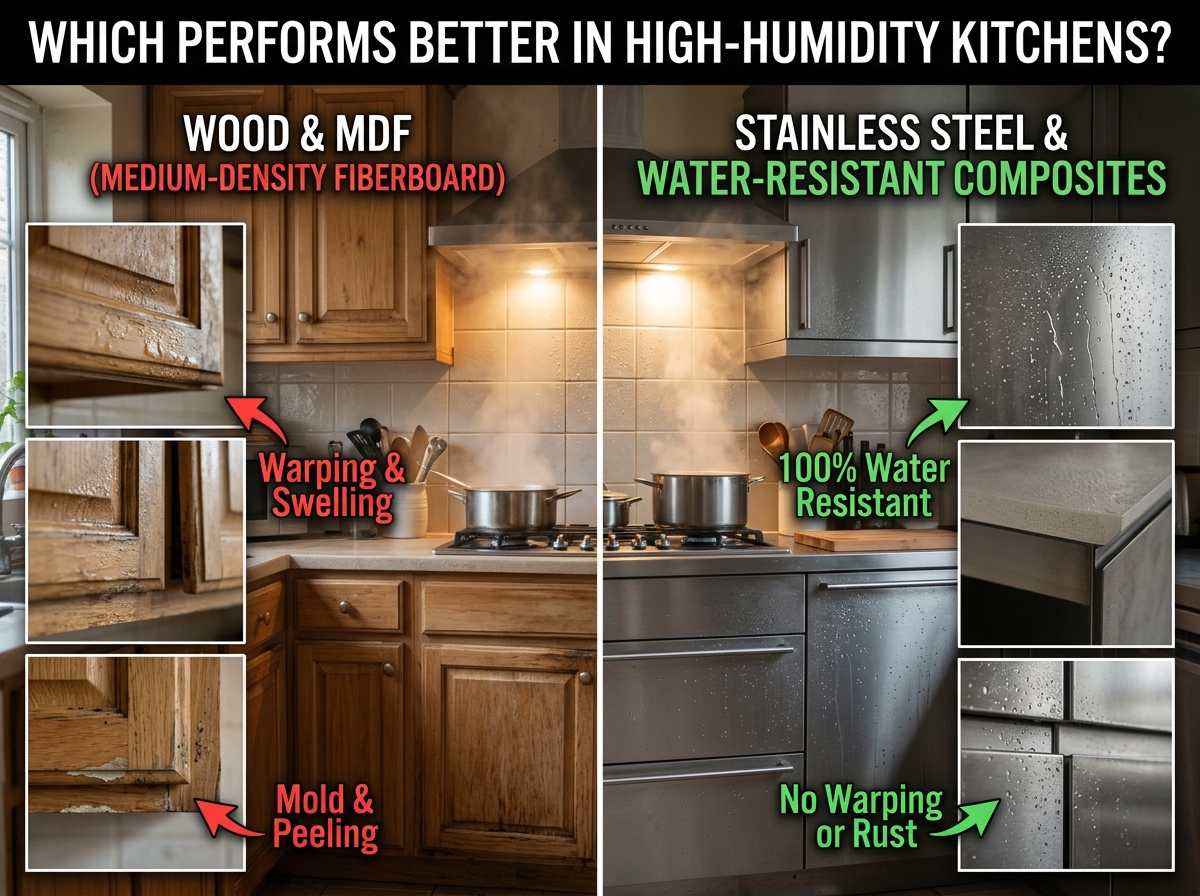
Cabinets near sinks experience a different type of moisture exposure from cabinets located elsewhere in the kitchen.
Water splashes, plumbing leaks, cleaning activities, and condensation can affect the interior and exterior surfaces of sink base cabinets. Direct water exposure is often more damaging than ordinary fluctuations in indoor humidity.
Quality plywood may provide useful structural performance, but it still requires protection from prolonged moisture. Cabinet edges, cutouts, and plumbing openings should be appropriately sealed according to the product’s construction requirements.
A removable protective tray or compatible under-sink liner may help contain minor spills and make leaks easier to detect. Such accessories should not conceal ongoing plumbing problems.
Homeowners should inspect sink cabinet interiors periodically. Early leak detection is often more important than selecting a material marketed as moisture-resistant.
Cabinet finishes create a protective surface that can influence how materials respond to moisture.
Painted cabinets rely on appropriate surface preparation, primer compatibility, coating quality, and complete coverage. Poorly sealed edges or damaged paint can allow moisture to reach the underlying substrate.
Laminate and thermofoil surfaces may provide a consistent decorative finish, but exposed seams and edges remain important considerations.
Excessive heat can also affect certain surface materials, particularly near ovens and other heat-producing appliances.
Homeowners should evaluate the complete cabinet construction rather than assuming that a decorative coating makes the underlying material waterproof.
Preventing moisture damage requires both suitable cabinetry and appropriate indoor conditions.
Effective kitchen ventilation helps remove cooking steam and reduce condensation. A properly installed range hood that exhausts outdoors, where feasible and permitted, can improve moisture management.
Indoor humidity should also be monitored when condensation or dampness becomes a recurring problem. The EPA generally recommends maintaining indoor relative humidity below 60%, ideally between 30% and 50%, to help control moisture and mold.
Practical prevention measures include:
These practices can help extend cabinet service life regardless of the materials selected.
Shaker cabinets remain a popular choice because their recessed-panel design works with traditional, transitional, and contemporary interiors.
However, the shaker profile itself does not determine moisture resistance. Performance depends on the door’s underlying materials, construction, finish, and environmental conditions.
A shaker door may incorporate solid wood framing, an engineered center panel, or another construction method. Each design should be evaluated according to its actual specifications.
Homeowners exploring Forevermark Cabinets should review the construction details of individual collections before selecting cabinetry for kitchens with elevated humidity.
The best cabinet door combines a suitable material, a protective finish, and construction designed to accommodate normal environmental conditions.
Marketing descriptions such as durable, premium, and moisture-resistant can be useful starting points, but they should not replace technical specifications.
Homeowners should ask what materials are used for cabinet boxes, doors, shelves, and drawer components. They should also examine panel thickness, assembly methods, edge treatment, and finish quality.
Warranty documentation deserves attention because coverage may exclude water damage, improper installation, or environmental conditions outside the manufacturer’s recommendations.
When comparing Forevermark Cabinets or other cabinet collections, verify the exact product specifications rather than assuming that every model uses identical construction materials.
A well-informed purchasing decision should account for kitchen conditions, budget, storage requirements, and long-term maintenance expectations.
Minor cosmetic damage may sometimes be repairable, depending on the cabinet material and finish.
Small scratches, limited finish deterioration, or isolated hardware problems may be addressed without replacing the entire cabinet.
However, significantly swollen MDF or particleboard often cannot be restored to its original dimensions. Structural deterioration, persistent mold contamination, or extensive water damage may make replacement more appropriate.
Before repairing or replacing cabinetry, identify and correct the moisture source. Installing new cabinets without addressing a leaking pipe or ventilation problem can lead to repeated damage.
Homeowners should assess the condition of cabinet boxes, doors, shelves, and surrounding surfaces before deciding which approach offers better long-term value.
A cabinet described as plywood or solid wood is not automatically superior to every alternative.
Construction quality includes panel thickness, joinery, fastener placement, hardware, finish application, and installation accuracy. These factors influence how cabinets respond to everyday use and environmental stress.
For example, a poorly assembled plywood cabinet with unprotected edges may experience moisture-related problems, while a properly manufactured engineered cabinet may perform effectively under appropriate conditions.
This is why comparing complete cabinet systems is more useful than evaluating materials in isolation.
At Cabinets House, homeowners can approach cabinet selection by considering construction, storage, style, and practical kitchen conditions together.
Quality plywood is often a strong option for cabinet boxes because of its dimensional stability and structural characteristics. Properly finished solid wood and moisture-resistant engineered materials may also be suitable for specific components.
Standard MDF can swell when exposed to excessive moisture, particularly through unsealed edges or damaged finishes. Proper sealing, suitable product selection, and humidity control help reduce this risk.
No. Plywood is not inherently waterproof. Its moisture performance depends on panel grade, adhesives, finish protection, and exposure conditions.
Yes. Solid wood expands and contracts as moisture conditions change. Proper door construction, finishing, and stable indoor humidity can help manage this natural movement.
Cabinetry with suitable moisture-resistant construction, protected edges, quality finishes, and appropriate hardware may be beneficial in coastal environments. Indoor humidity control and ventilation remain important.
Suitability depends on the specific Forevermark collection, cabinet materials, finish, installation conditions, and manufacturer recommendations. Homeowners should verify current specifications before purchasing.
Choosing the right kitchen cabinet material for high-humidity environments requires understanding how plywood, MDF, solid wood, and particleboard respond to moisture.
Quality plywood is often a practical option for cabinet boxes, while properly manufactured and finished MDF or solid wood can provide attractive cabinet door solutions. Particleboard may also serve in suitable applications, although moisture protection is especially important.
No cabinet material is completely immune to water damage. Protective finishes, sealed edges, effective ventilation, and prompt leak repairs are essential for maintaining long-term performance.
Homeowners comparing cabinetry should prioritize verified construction specifications rather than relying solely on material names or promotional claims.
With thoughtful planning and support from Cabinets House, selecting durable kitchen cabinetry becomes easier, helping homeowners create kitchens that balance moisture resistance, attractive design, practical storage, and lasting everyday value.
No account yet?
Create an Account